CIIL - NEWSLETTER , november 2026 - N° 20
Scientific Profile

After studying medicine in Lille and specializing in laboratory medicine, I obtained a PhD on innate immunity in the intestinal mucosa under Professor Michel Simonet at the CIIL. I studied how the intestinal epithelium responds to Yersinia pseudotuberculosis through TLR2 independently of the inflammasome. By comparing mice with and without a microbiota, I showed that its presence profoundly alters the host response to infection. I then explored how innate immune receptors help regulate the commensal microbiota.
I then joined Professor Benoît Guery's Host-Pathogen Translational Research team, later led by Professor Eric Kipnis, with whom I have worked since. This team’s existing focus Pseudomonas aeruginosa, an opportunistic Gram-negative bacterium that frequently causes respiratory infections in critically ill patients, led to one of my research themes. Given my previous expertise on Yersinia and the inflammasome, we studied its type III secretion system, which injects bacterial proteins into host cells, and its interaction with the NLRC4 inflammasome, an intracellular sensor that triggers inflammation. With Dr Sébastien Vidal's team, we then developed synthetic glycoclusters that inhibit bacterial adhesion by targeting bacterial secreted lectins LecA and LecB. This antivirulence strategy is designed as an adjunct to conventional antibiotics and is currently in an academic-industrial pre-clinical development pipeline.
My expertise in microbiota led to work with Professor Damien Subtil and the obstetrics team on the relationship between the vaginal microbiota and preterm birth. This work led to the PREMEVA randomized trial on early treatment of bacterial vaginosis during pregnancy.
With Eric Kipnis, we then merged with Dr Philippe Gosset's team into the Opportunistic Infection Immunity and Environment in Lung Disease, OpInfIELD team, at the CIIL. There I developed my research on the gut–lung axis.
We first studied antibiotic-induced dysbiosis and pulmonary immunosuppression. We then studied colonization resistance, which is the microbiota's capacity to prevent pathogens settling and expanding in the gut. I mentored Dr Rémi Le Guern on developing a mouse model of intestinal colonization with multidrug-resistant Klebsiella pneumoniae, in which we found that gut-colonization worsens subsequent Pseudomonas aeruginosa lung infection.
This model provided the basis for our current research. Since fecal microbiota transplantation or short-chain fatty acid (SCFA) supplementation improves infection outcomes in these mice, we endeavored to therapeutically modulate the colonized gut to improve outcomes of respiratory infection.
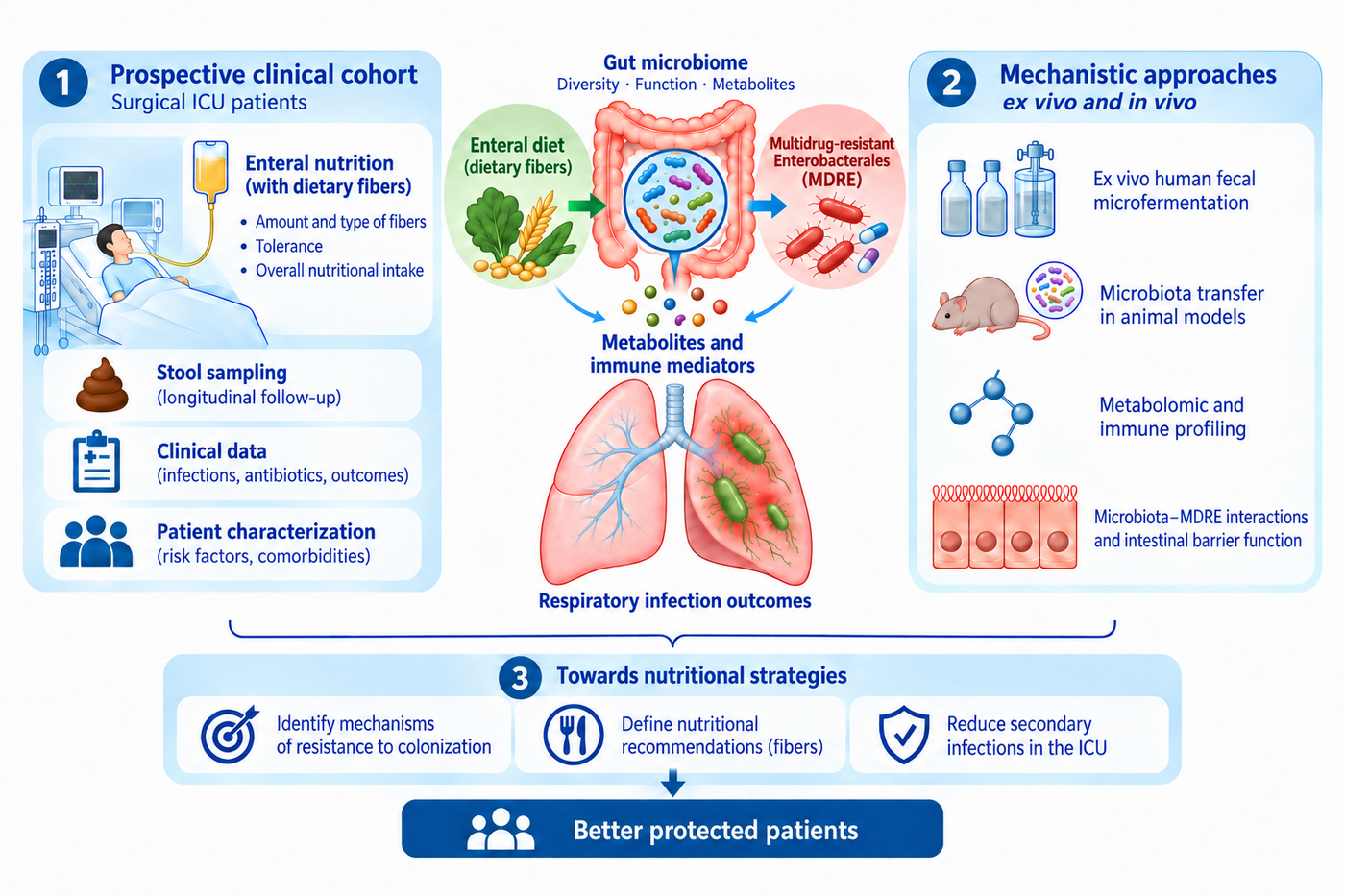
This is the core hypothesis of DEFENSIVE (Dietary Enteral Fibers in ENterobactertales gut-colonized intenSIVE care patients), an ANR-funded project (2025–2028), I coordinate. DEFENSIVE is investigating how enteral nutrition, particularly dietary fiber intake, shapes the gut microbiota, intestinal colonization by multidrug-resistant Enterobacterales, and the risk of secondary infections in surgical ICU patients. The project combines a prospective clinical cohort with stool sampling and detailed clinical and nutritional data with mechanistic ex vivo and in vivo approaches, including microfermentation, microbiota transfer and metabolomics. Its ultimate goal is to identify mechanisms and nutritional strategies that favorably modulate the gut-lung axis and improve outcomes of infectious complications in critically ill patients.