
Biofab and Mechanobiology
The platform covers the entire device development pipeline, from design to custom fabrication and analysis, relying on a complementary set of microfabrication, rapid prototyping, and microscopy technologies including super-resolution and AFM. It provides solutions adapted to a wide range of applications, with particular expertise in the development of advanced cell culture systems, notably organ-on-chip technologies, as well as applications in chemistry and bio-material interfaces.
Building on recognized expertise in mechanobiology, imaging, and biological systems engineering, the platform supports projects from feasibility studies and proof-of-concept stages through to the development of robust, reproducible devices compatible with valorization and technology transfer approaches. It thus contributes to strengthening interdisciplinary research and enhancing the visibility of CIIL scientific collaborations.
Expertise and equipment
3D Printing and microfabrication
The platform is equipped with stereolithography (SLA) and digital light processing (DLP) 3D printers enabling rapid and high-precision fabrication of devices, molds, and components for microfabrication and biomedical engineering applications.
Equipment: Formlabs 2, Formlabs 3, Formlabs 4, Formlabs 4B (biocompatible).
A laser cutting and engraving system enables the fabrication and customization of polymer, wood, or acrylic parts, as well as engraving on selected metals and glass.
Equipment: Beambox Pro 50W Laser Cutter (FLUX).
A simple thermoforming system is also available, allowing rapid replication of plastic molds.
Equipment: FormBox (Mayku).
Post-processing
Dedicated washing and UV curing stations ensure controlled post-processing of 3D-printed parts, guaranteeing mechanical performance, dimensional accuracy, and compatibility with biological applications.
Equipment: Form Wash (Gen 1 & 2), Form Cure (Gen 1 & 2), dedicated workstations.
Digital design and simulation
The platform provides computer-aided design tools for 3D device modeling, as well as multiphysics simulation tools for the analysis of mechanical, fluidic, and physical behaviors (deployment ongoing).
Equipment: Fusion 360 (Autodesk), COMSOL Multiphysics (coming in 2026).
Chemistry and surface preparation
A dedicated chemical hood enables surface preparation, silanization, and physico-chemical treatments required for the fabrication and functionalization of microfabricated devices.
Equipment: vacuum desiccator, hot plates, associated equipment.
PDMS and microfluidics station
A dedicated PDMS workstation supports the prototyping and fabrication of microfluidic chips, including molding, bonding, and the fabrication of thin membranes with controlled mechanical properties.
Equipment: PDMS workbench, spin coater (Laurell), associated equipment.
Microfluidic flow controllers
Microfluidic flow controllers enable precise control of flow rates and dynamic conditions within microfluidic devices, particularly for organ-on-chip applications.
Equipment: FlowEZ systems (Fluigent).
Micropatterning and surface structuring
An optical micropatterning system enables spatial surface structuring, hydrogel polymerization, and the generation of bespoke in vitro cellular microenvironments.
Equipment: PRIMO (Alvéole).
A UV-ozone device is used for surface cleaning and activation prior to bonding or functionalization.
Equipment: UV-Ozone Cleaner Model 24 (Jelight).
Mechanical and Nanometric Characterization
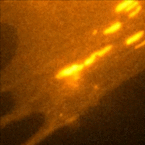
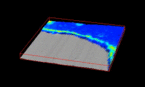
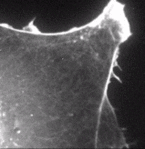
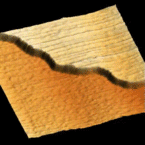
Several atomic force microscopes (AFM) are available, some coupled with photon microscopy, enabling high-resolution studies of the topographical, mechanical, and adhesion properties of materials and biological systems: biomolecules, cells, and tissues. The platform also provides expertise and resources for data analysis.
Equipment:
- Bruker-JPK NanoWizard V coupled with an Abberior Instruments STED super-resolution microscope
- Bruker-JPK NanoWizard III Ultra coupled with an inverted widefield microscope, BioMat, and FluidFM technology
- Bruker BioScope Resolve coupled with a Zeiss Elyra P1 super-resolution microscope
Bruker FastScan Bio
Bruker Multimode 8
Access
For most equipment, an initial training is mandatory for granting access to the open facility. Then, researchers can independently book and operate the instruments. Dedicated technical support is mandatory and provided for AFM-based approaches.
Training
Training sessions can be provided for each technology, depending on user needs and project requirements.
Staff
Scientific Director: Alexandre Grassart
Team members: Sébastien Janel (CNRS Research Engineer), Elizabeth Werkmeister (CNRS Research Engineer), Nicolas Barois (IR Inserm)