
Evolutionary and Environnemental Microbiology

Damien DEVOS
IPL research director
Damien's ORCID
Damien's Contact
For several decades, biologists have focused their efforts on known model microorganisms leading to significant advances in fundamental cellular and molecular biology with multiple applications, in particular in public health and study of evolution of life. However, the biodiversity of the living world is much broader than the limited number of organisms that can be grown in the laboratory and there is a lot more to be learned from others organisms. This is why the E2M team proposes to study under-investigated non-model organisms of prokaryotes and unicellular eukaryotes, which all share known major environmental, evolutionary and/or public health implications.
E2M will thus occupy a real niche with an international recognition on still neglected bacteria and protozoa. The organisms studied include 1) bacteria from the Planctomycetes, Verrucomicrobia, and Chlamydiae (PVC) superphylum showing novel divergent biology and having recently risen as one of the most attractive bacterial group and 2) intestinal protozoa belonging to the genera Blastocystis and Cryptosporidium which both contribute significantly to the burden of infectious diseases by affecting hundreds of millions of people worldwide.
Through a pluri-species research project, our main challenges will be in the coming years to solve the exciting issues of how related PVC bacteria having a common ancestor have diverged so considerably as well as the evolution of pathogenicity in this group (Axis 1) and to decipher ecology and transmission dynamics through large-scale epidemiological surveys and physiopathology of the enteric parasites Blastocystis and Cryptosporidium (Axis 2). The approaches we will develop are highly interdisciplinary, covering the whole spectrum of biology from genes and cells to communities and ecosystems through laboratory research and field studies via the sampling of the hosts and their environment. Our work involves a wide range of computational and experimental approaches that will be used to address each of these challenges while benefiting from campus facilities.
Project leader Axis 1: DEVOS Damien
Project leaders Axis 2: VISCOGLIOSI Eric / CERTAD Gabriela
We work on PVC bacteria, in particular on bacteria from the phylum Planctomycetota. Planctomycetes are found to be primarily associated with particles, microbial mats, and biofilm. Various members of this peculiar bacterial phylum display features that are usually not seen in bacteria, including cell morphologies, a developed endomembrane system sustained by membrane coat proteins, and the capacity to synthesize sterol lipids. Here, we study some of the most conspicuous aspects of those fascinating bacteria.
Project leader : DEVOS Damien
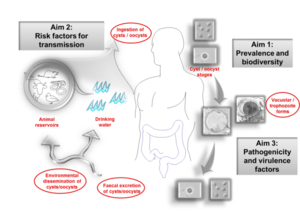
The intestinal parasitic protozoa Blastocystis and Cryptosporidium, which currently represent major socioeconomic and public health problems. Both parasites are responsible for gastrointestinal infections which, in the case of Cryptosporidium, can be serious or even fatal in children and immunocompromised patients. However, these parasites are still poorly studied and generally overlooked by health authorities, while little or no treatment is effective against these parasites. Moreover, these two parasites, presenting a great genetic diversity and being able to colonize many hosts, also represent relevant models to investigate a major biological question in the field of "Ecology of Health": what is the nature of the genetic diversity of these parasites and its impact on the circulation and pathogenicity of different species, subtypes and genotypes? The current and future work of this project, which has the particularity of combining "field studies" and "laboratory research", aim to clarify the molecular epidemiology of these parasites (Aim 1), their circulation in human and animal populations as well as in the environment (research of transmission risk factors) (Aim 2) and their pathophysiology while identifying molecules and mechanisms involved in the pathogenesis of these parasites (Aim 3). Our goal is to propose strategies to implement urgent prevention and control measures to significantly reduce the incidence of these parasites.
To carry out its activities, we combines molecular epidemiology and phylogeny, comparative genomics, transcriptomics and proteomics, metagenomics and cell and molecular biology approaches together with the development of in vivo, ex vivo and in vitro study models. We have developed a large and well-targeted network of regional, national and international collaborations. Finally, because of its rare expertise in protistology, our know-how is requested for specific collaborations, in particular in the context of the molecular identification of parasitic protozoa of interest in human and animal health or as coordinator / partner of funded projects funded in the fields of parasitology (fish parasites) and environmental parasitology.
Project leader : VISCOGLIOSI Eric / CERTAD Gabriela
ABDALLAH Dima
PhD student
Contact
CERTAD Gabriela
Assistant-Professor GHICL
Contact
DENOYELLE Constance
PhD student
Contact
DEVOS Damien
IPL Researcher
ORCID
Contact
Learn more about Damien
DESMARAUT Jeremy
IPL Technician
Contact
GANTOIS Nausicaa
IPL engineer (IE)
Contact
GARCIA DOMINGUEZ Ruben
PhD student
GOSSET Pierre
Hospital practitioner GHICL
Contact
LAMISSE Maëlle
Master 2 student
LONIGRO Manuel
PhD student
Contact
MIHALACHE Adriana
Hospital practitioner GHICL
Contact
MURIEL-MILLAN Luis Felipe
Post-Doc
Contact
REBOUL Angeline
Post-Doc
Contact
RYCKMAN Manon
PhD student
Contact
VISCOGLIOSI Eric
CNRS Research Director
ORCID
Contact
VIGIL VASQUEZ Carlos
PhD student
Contact
- A century of research on the Planctomycetota bacterial phylum, previously known as Planctomycetes. [1]
- Lage OM, Godinho O, García-Domínguez R, Øvreås L, DEVOS DP. FEMS Microbiol Rev. 2025 Jan 14;49:fuaf056. doi: 10.1093/femsre/fuaf056. PMID: 41206740 Verrucomicrobium spinosum_ essential genome and the divergence of cell division in the PVC superphylum. [2]
- Henriques V, Moyano-Palazuelo D, Alonso-Pascual MT, Pazos M, DEVOS DP, Rivas-Marin E. iScience. 2025 Jun 30;28(8):113037. doi: 10.1016/j.isci.2025.113037. eCollection 2025 Aug 15. PMID: 40703445
- Essential gene complement of Planctopirus limnophila from the bacterial phylum Planctomycetes. [3] Rivas-Marin E, Moyano-Palazuelo D, Henriques V, Merino E, DEVOS DP. Nat Commun. 2023 Nov 9;14(1):7224. doi: 10.1038/s41467-023-43096-3. PMID: 37940686
- The squalene route to C30 carotenoid biosynthesis and the origins of carotenoid biosynthetic pathways.
Santana-Molina C, Henriques V, Hornero-Méndez D, Devos DP, Rivas-Marin E. Proc Natl Acad Sci U S A. 2022 Dec 27;119(52):e2210081119. doi: 10.1073 pnas.2210081119. Epub 2022 Dec 19. PMID: 36534808 - Reconciling Asgardarchaeota Phylogenetic Proximity to Eukaryotes and Planctomycetes Cellular Features in the Evolution of Life.
Devos DP. Mol Biol Evol. 2021 Aug 23;38(9):3531-3542. doi: 10.1093/molbev/msab186. PMID: 34229349 - Origin and Evolution of Polycyclic Triterpene Synthesis.
Santana-Molina C, Rivas-Marin E, Rojas AM, Devos DP. Mol Biol Evol. 2020 Jul 1;37(7):1925-1941. doi: 10.1093/molbev/msaa054. PMID: 32125435 - Non-essentiality of canonical cell division genes in the planctomycete Planctopirus limnophila.
Rivas-Marin E, Peeters SH, Claret Fernández L, Jogler C, van Niftrik L, Wiegand S, Devos DP. Sci Rep. 2020 Jan 9;10(1):66. doi: 10.1038/s41598-019-56978-8. PMID: 31919386 - Essentiality of sterol synthesis genes in the planctomycete bacterium Gemmata obscuriglobus.
Rivas-Marin E, Stettner S, Gottshall EY, Santana-Molina C, Helling M, Basile F, Ward NL, Devos DP. Nat Commun. 2019 Jul 2;10(1):2916. doi: 10.1038/s41467-019-10983-7. PMID: 31266954