CIIL - NEWSLETTER , January 2026 - N° 18
Portrait des Doctorants

Having been interested in the living world from a very young age, it was only natural that my favourite subject at school was Life and Earth Sciences. I therefore went on to study for a scientific baccalaureate and then a Bachelor’s degree in Biology at the University of Tours. Once I had completed my Bachelor’s degree, I continued my studies with a Master’s in Infectiology, Immunology, Vaccinology and Biomedicines. I undertook my first-year Master’s placement under the supervision of Emilie Camiade, in the Bacteria and Materno-Foetal Risk team, working on Streptococcus agalactiae. This placement enabled me to gain my first experience in a research laboratory and to specialise in bacteriology and molecular biology techniques. Interested in host-pathogen interactions and the immune response associated with infections, I joined the Cellular and Molecular Infectiology specialisation during the second year of my Master’s degree. As part of this, I undertook a six-month placement in Lille, within the Bacteria, Antibiotics and Immunity team, during which I worked on Streptococcus pneumoniae under the supervision of Jean-Claude Sirard. I had the opportunity to continue with a PhD within the same team thanks to funding from the European NOSEVAC project.The aim of this thesis is to identify new virulence factors of S. pneumoniae using in vivo CRISPRi screening in a mouse model of pneumonia, and subsequently to validate their contribution to virulence and nasal colonisation, as well as their ability to induce an immune response. An initial S. pneumoniae virulence factor, LafB, had been identified and validated as a protective antigen prior to my arrival at the laboratory. This LafB factor serves as a prototype antigen for exploring the immune mechanisms associated with protection, at both the local and systemic levels. To consolidate the proof of concept and analyse the mechanisms involved, I am developing, in collaboration with teams from the NOSEVAC consortium, new vaccine formulations containing LafB in the form of a protein or mRNA. During my PhD, I also established a model of nasal colonisation by pneumococcus in order to study the molecular determinants associated with nasal colonisation and to characterise the nasal immune and microbial environment that regulates colonisation.
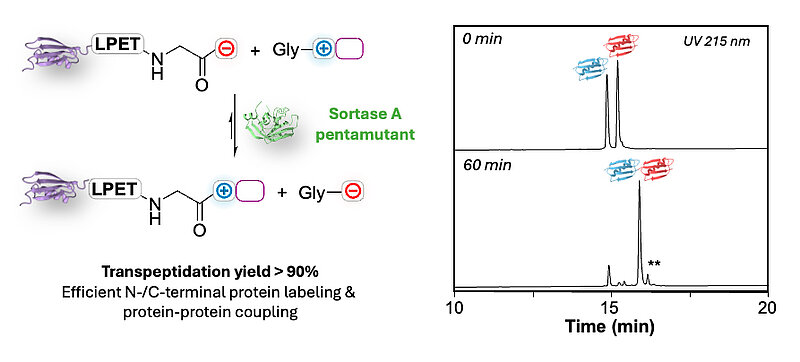
Thanks to the support of the China Scholarship Council (CSC), I arrived in France in September 2023 to join Oleg Melnyk’s group to undertake my PhD. I spent the first two years of my PhD studying enzyme-catalysed transpeptidation reactions, and more specifically sortase A-mediated ligations. Sortase A is a cysteine transpeptidase that plays a crucial role in anchoring proteins to the cell surface of Gram-positive bacteria. It has become increasingly popular over the years, as it also allows proteins to be modified in vitro or in vivo with remarkable selectivity and under mild conditions. In this context, my project aims to optimise these enzyme-catalysed ligation reactions in order to improve their efficiency. To achieve this, we have exploited the unique electrostatic properties of a sortase A variant, enabling us to obtain conjugates with high yields (figure below).
During the final year of my PhD, I hope to make use of these sortase A-mediated ligation strategies to synthesise high-molecular-weight protein biopolymers whose mechanical properties mimic those of muscle.
Looking back over the last two years, my time at the CIIL has been both meaningful and rewarding. I feel truly fortunate and deeply grateful for the support and encouragement offered by the entire CIIL community.
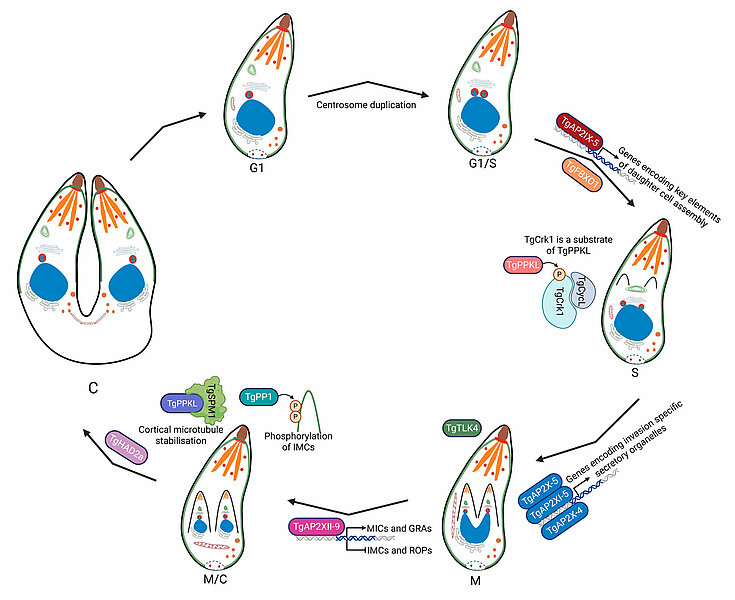
Our laboratory studies the biology of Toxoplasma gondii, an intracellular parasite capable of infecting almost all warm-blooded animals and which can cause serious diseases. My PhD research focuses on the ApiAP2 transcription factors, which are specific to apicomplexans. I have shown that the one I am studying acts as a repressor during the asexual cycle by regulating ribosomal DNA transcription and the expression of mitochondrial genes, making it a promising therapeutic target.
Outside the laboratory, I enjoy cooking, discovering new restaurants, playing sport, travelling and taking part in science outreach activities.