
CIIL - NEWSLETTER , June 2026 - N° 19
Engineer Profiles
I joined the IBL in May 1997, where I began my research as part of a PhD thesis within Yvan de Launoit’s team. He also headed a laboratory at the Université Libre de Bruxelles, where I defended my thesis and was awarded my PhD. My research focused on the study of the BRCA2 gene, a tumour suppressor gene whose mutations are associated with an increased risk of breast and ovarian cancer. These alterations, which are often hereditary, are now the subject of numerous studies.
After completing my PhD in 2002, I moved to the fourth floor of the institute, where I have continued my work ever since, joining the virology team led by Jean Dubuisson. In 2005, I was appointed as a Research Engineer at the CNRS, and I was recently promoted to Senior Research Engineer. The laboratory has always focused on positive-sense RNA viruses, with the viral models studied evolving over time. My work initially focused on the mechanisms by which the hepatitis C virus (HCV) enters target cells.
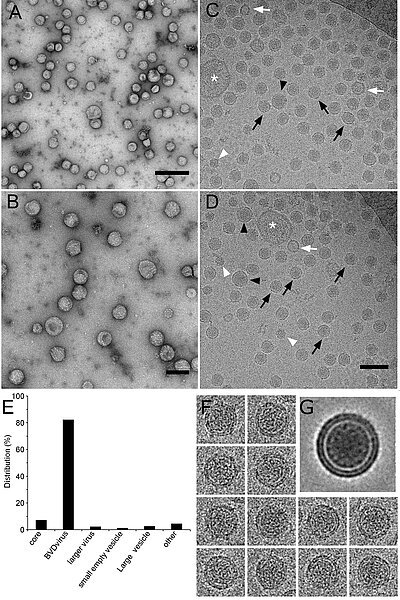
I continued my research into positive-sense RNA viruses, notably by developing a method for purifying bovine viral diarrhoea virus (BVDV) virions. This enabled us to study the morphology of these particles using cryo-electron microscopy (figure), as well as their protein and lipid composition using mass spectrometry.
In 2020, against the backdrop of the COVID-19 pandemic, I joined the ‘Coronavirus’ group led by Sandrine Belouzard, who is now head of the MCV laboratory. In collaboration with Dr Rouillé, I contributed to the development of an automated system for measuring SARS-CoV-2 infection. This system is based on reporter cell lines that enable high-throughput screening of antiviral molecules: they express a fluorescent probe located in the cytoplasm of uninfected cells, which relocates to the nucleus following infection.
I am currently working on the development of a similar system aimed at identifying new targets and characterising the mode of action of broad-spectrum antivirals directed against coronaviruses. At the same time, I am interested in the prevention and control of the infectious risk associated with African strains of the Zika virus. This project involves designing tools essential for establishing infection monitoring systems, enabling both high-throughput screening of antiviral compounds and the identification of cellular factors involved in infection.
In addition to my research work, I am responsible for teaching modules in virology at the University of Lille. Finally, in collaboration with Alexis, I also ensure the smooth running of the laundry facilities at the Lille Institute of Biology.
Since joining the IBL in 1997, my career has thus gradually expanded and diversified. It has also enabled me to meet many colleagues and students, both at the institute and at the university, which is a particularly rewarding aspect of my work.