
CIIL - NEWSLETTER , January 2026 - N° 18
Portrait d'une Post-Doctorante

Becoming a researcher has always been a calling for me, fuelled from childhood by a deep curiosity about living things. I would spend hours observing plant leaves under a microscope, preparing smears and marvelling at the invisible world. This early passion naturally led me towards an academic career in biology. I went on to obtain a bachelor’s degree in experimental and analytical biology, followed by a master’s degree in microbiology and molecular epidemiology at the Faculty of Sciences at Tunis El Manar. This journey enabled me to consolidate my scientific foundations and reaffirm my commitment to research.
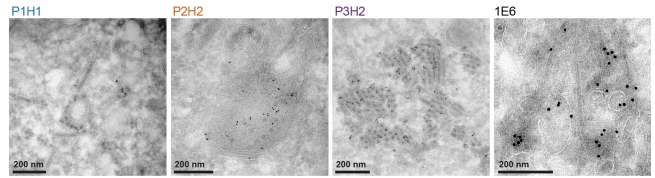
I subsequently completed my PhD in the Molecular and Cellular Virology Laboratory at the Lille Centre for Infection and Immunity (CIIL), under the supervision of Laurence Cocquerel. The first part of my PhD work involved characterising the viral assembly complexes of the hepatitis E virus (HEV) using monoclonal antibodies directed against the ORF2 capsid protein, which were generated by the laboratory. Characterisation of these antibodies demonstrated their functionality in various experimental approaches. Importantly, these anti-ORF2 antibodies enabled the first-ever visualisation, via electron and confocal microscopy, of structures specifically induced by HEV and serving as its viral factory (Figure 1).
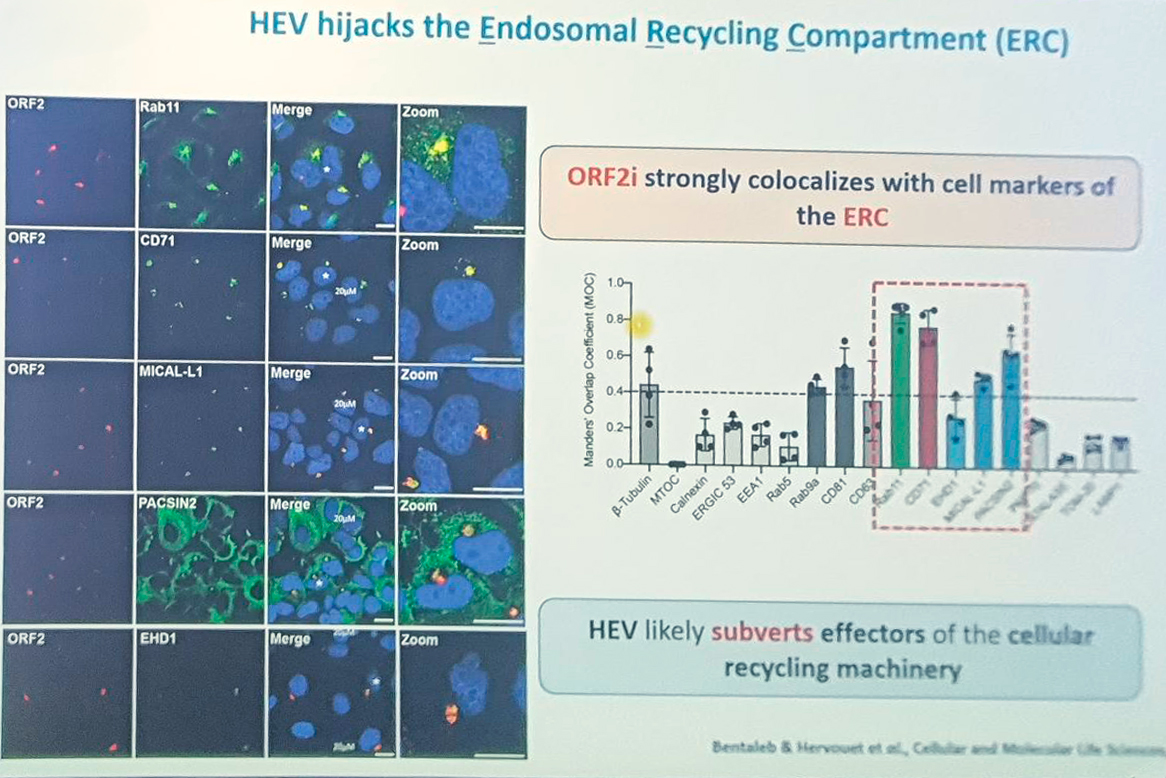
In the second part of my PhD thesis, we characterised the HEV ORF1 replicase using various approaches, and sought to determine whether it underwent maturation within the host cell. My PhD research has thus provided a wealth of new insights into the interaction between HEV and its host cell. My thesis was awarded the first prize for a thesis on viral hepatitis, generously awarded by the ANRS-MIE and the French Society of Virology for the year 2023. (Figure 2)
Since March 2023, I have been carrying out a postdoctoral project funded by Sidaction at the CIIL, within the emerging ‘Chronicity of Viral Infections’ team led by Fernando Real. As part of my project, I am working on the study and characterisation of under-explored HIV-1 reservoirs, in particular megakaryocytes. I have developed an in vitro differentiation system that enables the generation of megakaryocytes from CD34-positive precursor cells derived from umbilical cord blood. (Figure 3)
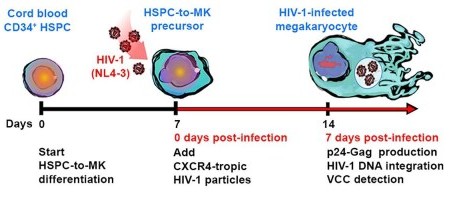
This model enabled me to study HIV-1 infection of megakaryocytes using RNA hybridisation-based techniques, such as Fish-flow and RNAscope. A major finding of this project was the demonstration of the presence of HIV-1 viral RNA in platelets. Our results showed that this RNA originates from megakaryocytes – the precursor cells of platelets – which can become infected and produce platelets containing viral RNA. At the same time, the characterisation of IFITM3 revealed its essential role in the antiviral defence of megakaryocytes. Overall, my project has demonstrated that megakaryocytes constitute a neglected reservoir for HIV-1 and represent a new potential target for improved antiretroviral therapies that could contribute to the eradication of the virus.
I am currently developing a new line of research that builds on my PhD work and postdoctoral research, forming part of a coherent scientific continuum. This line of research aims to further investigate co-infections between hepatitis viruses and HIV-1, in order to better understand their interactions within the host and their impact on viral persistence. By exploring these complex dynamics, my project aims to identify new mechanisms involved in viral persistence and escape, and to pave the way for innovative therapeutic approaches.