ImmunAge
Coordinator : François TROTTEIN
Contact : Mail
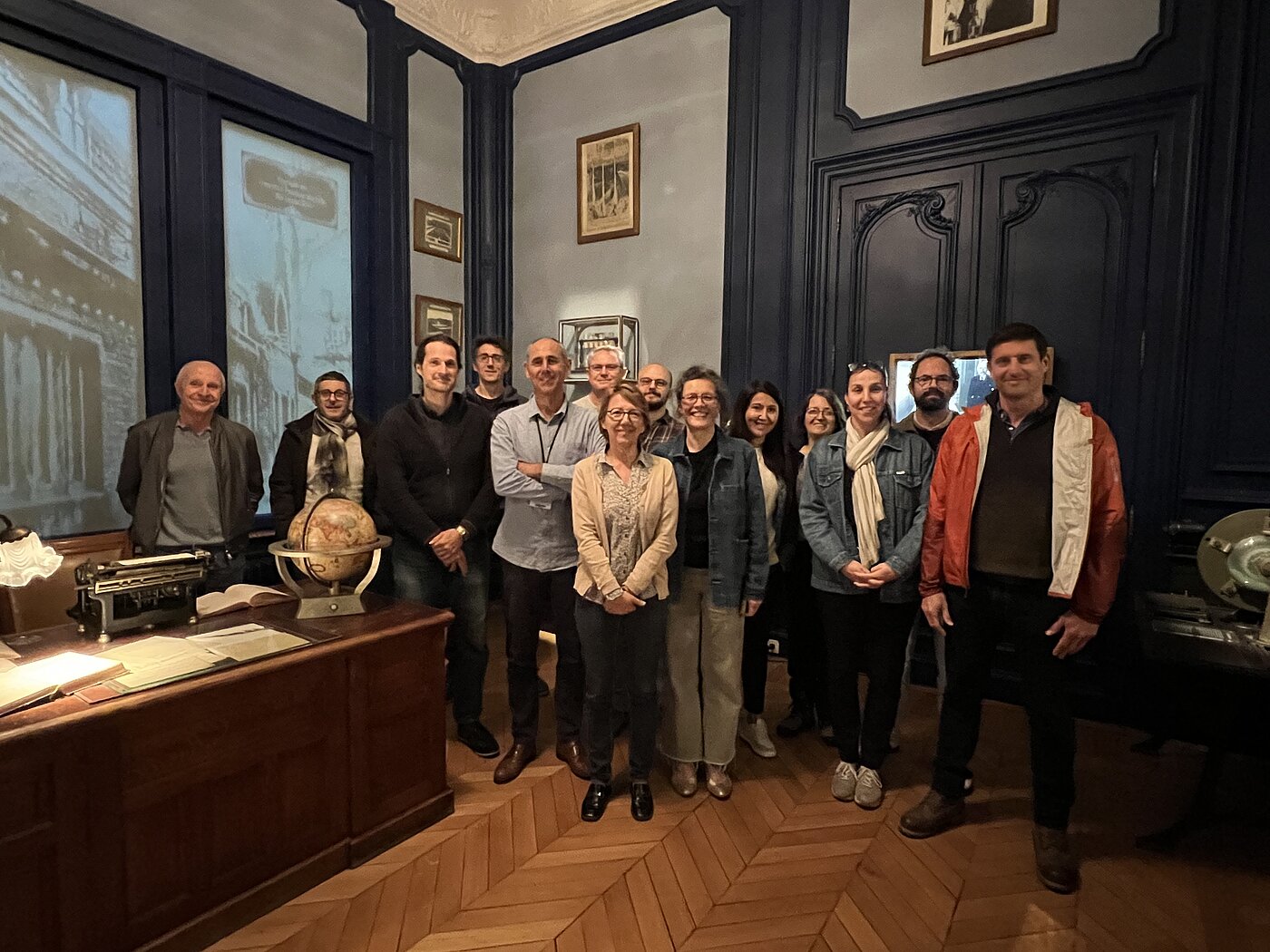
During the first symposium held at the Pasteur Institute of Lille, the participating scientists visited the Institute's museum. From left to right : Michel Cogné, Jean Marc Brondello, Victor Appay, Marc Bajenoff, François Trottein, Emmanuel Clave, Sandrine Henri, Alexandre Gallerand, Anne Sophie Beignon, Agnès Coste, Christine Bourgeois, Delphine Sauce, João Cardeira-Da-Silva and Nicolas Espagnolle
Aging is the primary risk factor for many chronic diseases that significantly impair quality of life. The progressive deterioration of the immune system reduces the body's ability to fight infectious agents and tumor cells and compromises tissue repair mechanisms following injury. Understanding the mechanisms underlying age-related immune dysfunction is therefore essential for identifying new therapeutic targets and promoting healthy aging. This complex field of research requires a multidisciplinary approach to unravel the multifactorial causes of declining immune function and its impact on age-related diseases. In the context of global population aging, the medical and socioeconomic challenges are considerable, as are the scientific ones. In response to these challenges, and with the support of the CNRS, we have established a national basic research network dedicated to studying the biological processes underlying immune system aging (coordinator : François TROTTEIN). Reducing this decline could significantly improve the health and well-being of older populations.
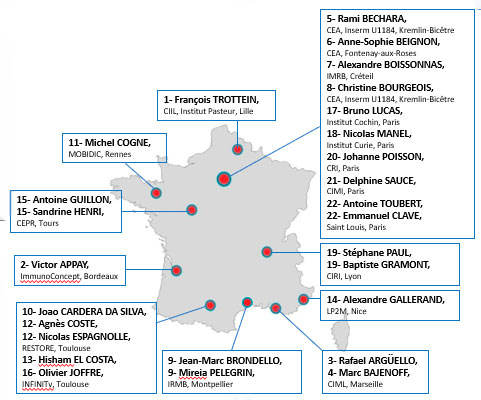
The ImmunAge thematic network, funded by the CNRS, brings together 22 teams with complementary expertise, some of which have gained international recognition for their work on aging. The main objectives of the IMMUNAGE thematic network for the 2026–2028 period are to: (i) unite these teams around shared scientific priorities, (ii) strengthen and stimulate scientific and technical exchanges and collaborations, and (iii) promote the sharing of know-how, experimental models, and state-of-the-art equipment. Two major research areas have been defined: (i) the molecular and cellular bases of immune aging, and (ii) the development of interventional strategies targeting the immune system to promote healthy aging. Our goal is to foster the emergence of national collaborations, innovative research themes, and breakthrough projects addressing the challenge of “Aging and Immunity.”
ImmunAge has established a scientific networking program that includes one webinar every six weeks and the organization of two scientific symposia over the 2026–2028 period, together with a targeted communication strategy. In the long term, the network will enhance scientific excellence, foster the generation of new knowledge, and increase the international visibility of the participating French research laboratories. Beyond addressing a major public health challenge, the network also has the potential to generate novel concepts in the biology of aging. By strengthening collaborative interactions, ImmunAge will enable participating teams to build ambitious and innovative research consortia capable of successfully competing for funding through major national and European research programs.
The inaugural ImmunAge symposium was held in Lille on May 18–19, 2026. The meeting provided an excellent platform for scientific exchange and resulted in the initiation of several collaborative research projects.
Particpants
- François TROTTEIN, CIIL CNRS UMR 9017, INSERM U1019, Institut Pasteur de Lille (responsable du réseau ImmunAge et bureau)
- Victor APPAY, ImmunoConcept, CNRS UMR 5164, INSERM U1303, Univ Bordeaux (bureau)
- Rafael ARGÜELLO, CIML, CNRS UMR 7280, Inserm U1104, Univ Marseille
- Marc BAJENOFF, CIML, CNRS UMR 7280, Inserm U1104, Univ Marseille
- Rami BECHARA, INSERM U1184, Le Kremlin-Bicêtre, Faculté de Médecine de Paris-Saclay
- Anne-Sophie BEIGNON, IMVA-HB/IDMIT/UMRS1184), Paris-Saclay, Inserm, CEA
- Alexandre BOISSONNAS, IMRB, INSERM U955, Université Paris-Est Créteil UPEC
- Christine BOURGEOIS, IMVA-HB/IDMIT/UMRS1184), Paris-Saclay, Inserm, CEA
- Jean Marc BRONDELLO/Mireia PELEGRIN, IRMB, Inserm U1183, Univ Montpellier
- João CARDERA DA SILVA, Institut RESTORE, CNRS UMR 1301, U5070, EFS, Univ Paul Sabatier
- Michel COGNE, INSERM U1236, Faculté de Médecine de Rennes et EFS Bretagne
- Agnès COSTE/Nicolas ESPAGNOLLE, Institut RESTORE, CNRS UMR 5070, U1301, Toulouse
- Hicham EL COSTA, Infinity CNRS UMR 5051 - U1291, Univ Toulouse
- Alexandre GALLERAND, LP2M, CNRS UMR 7370, Univ Côte d’Azur, Nice
- Antoine GUILLON/Sandrine HENRI (bureau), CEPR, INSERM U 1100, Hôpital Bretonneau, Univ Tours
- Olivier JOFFRE, Infinity - CNRS UMR 5051 - U1291, Univ Toulouse
- Bruno LUCAS, Institut Cochin, Paris, CNRS UMR 8104, InsermU1016, Univ Paris Cité
- Nicolas MANEL, Institut Curie, INSERM U932
- Stéphane PAUL/Baptiste GRAMONT, CIRI, CNRS UMR 5308, U1111, Univ Saint-Etienne/Lyon
- Johanne POISSON, UMR 1149 Inserm, ERL CNRS 8252
- Delphine SAUCE (bureau)/Martin LARSEN, CIMI, Inserm U1135, Sorbonne Univ
- Antoine TOUBERT/Emmanuel CLAVE, Institut de Recherches Saint-Louis, Inserm U1342,Univ Paris Cité